
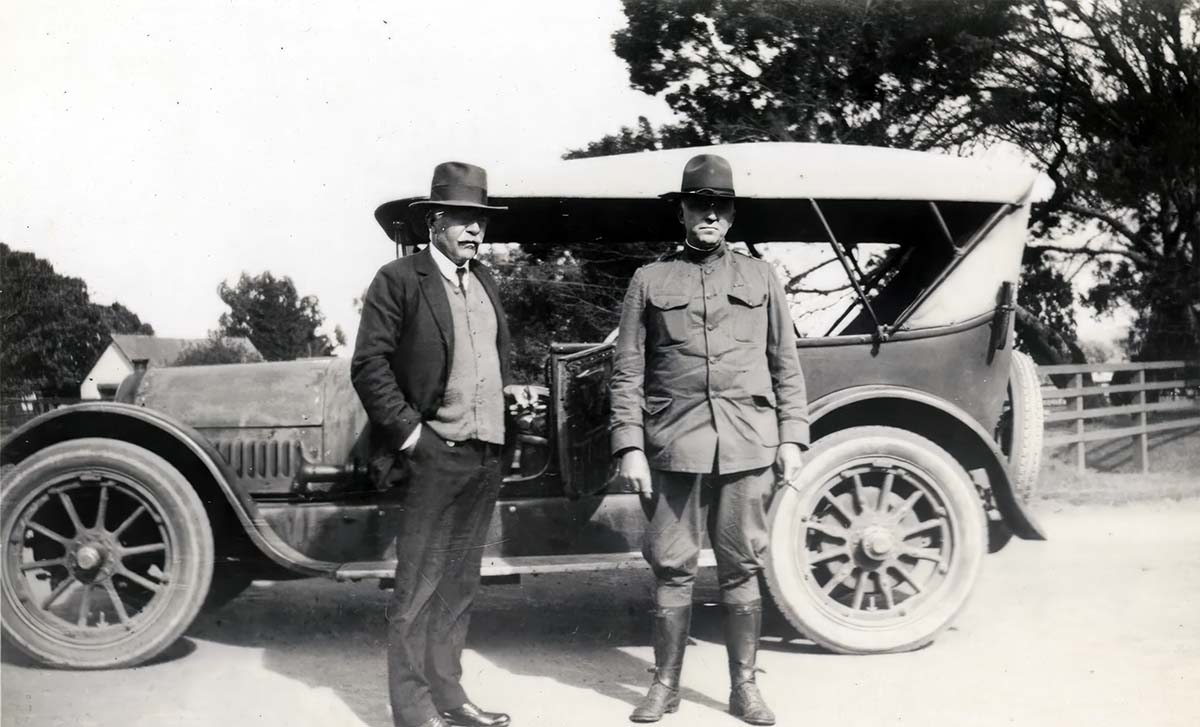
A.W. Carter and General George Patton
There’s a paddock in remote upcountry on the Big Island that’s been called “Kalikimaka”—Hawaiian for Christmas—for nearly a century. There’s a story behind that name, and it tells you a lot about A.W. Carter, who transformed Parker Ranch and earned the Hawaiian name “Makua” (father) for the way he treated the people who worked there.
A.W. Carter Takes the Reins
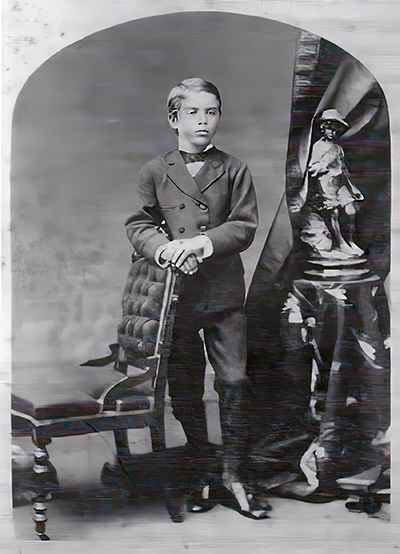
A.W. Carter at 9 years old
Alfred Wellington (A.W.) Carter (1867-1949) grew up in a Massachusetts seafaring family, but Hawaii became his home. After Yale Law School and years as a lawyer and judge, he did something unexpected in 1899—he took over management of Parker Ranch on the Big Island.
What he found wasn’t pretty. The ranch had 25,000 cattle on exhausted land, and the five-year-old steers weighed barely 500 pounds. A.W. got to work right away—he stopped shipping cattle, fixed up water systems and fencing, and brought in better breeding stock. What sets him apart is that he genuinely cared about the people who worked the ranch, and set a precedent in that respect. As “Makua,” he helped the paniolo buy their own homes with interest-free loans, created an educational trust for their kids, and pushed to bring medical services to isolated Waimea. He believed that when workers had stable homes and were happy, the ranch succeeded. He was truly a lifelong horse fanatic—as a kid, he’d ditch Sunday school to watch bush track races. Years later, he named his polo pony “Carry the News” after his favorite racehorse.
How the Paddock Got Its Name
The Kalikimaka Paddock story really captures what the relationship between A.W. and the paniolo was like. In mid-December 1900, he spent ten hard days working right alongside the ranch hands to fence off open range. With just one day to go and forgetting it would be a holiday; he asked everyone to meet at 4 a.m. to wrap things up. Every single person showed up and they worked straight through until 5 p.m.—on Christmas Day.
A week or so later, A.W. overheard the foreman, Old Tom Lindsey, referring to the new fence as the “Kalikimaka paddock.” He wasn’t too pleased. Who gave it that name? Who decided workers would miss Christmas? When he confronted Lindsey, the foreman set him straight: the paniolo knew the last day of work would be Christmas, but they showed up anyway to finish what their boss had asked them to do.
He realized what he’d done—he’d been so wrapped up in getting the job completed that he’d completely lost track of what day it was. Moved by their loyalty and more than a little embarrassed by his mistake, he accepted the paddock name, and it’s been called the Christmas paddock ever since.
A century later, the land came full circle: the paddock now sits in the lower Pu’ukapu Farm Lots on Hawaiian Homelands, awarded to Henry Ah Fong Ah Sam by the Department of Hawaiian Homelands, then passed to his daughter Annie Ah Fong Stevens, then to her daughter Lehua Stevens Ho’opai as successor, returning the land to generations of a Hawaiian family.
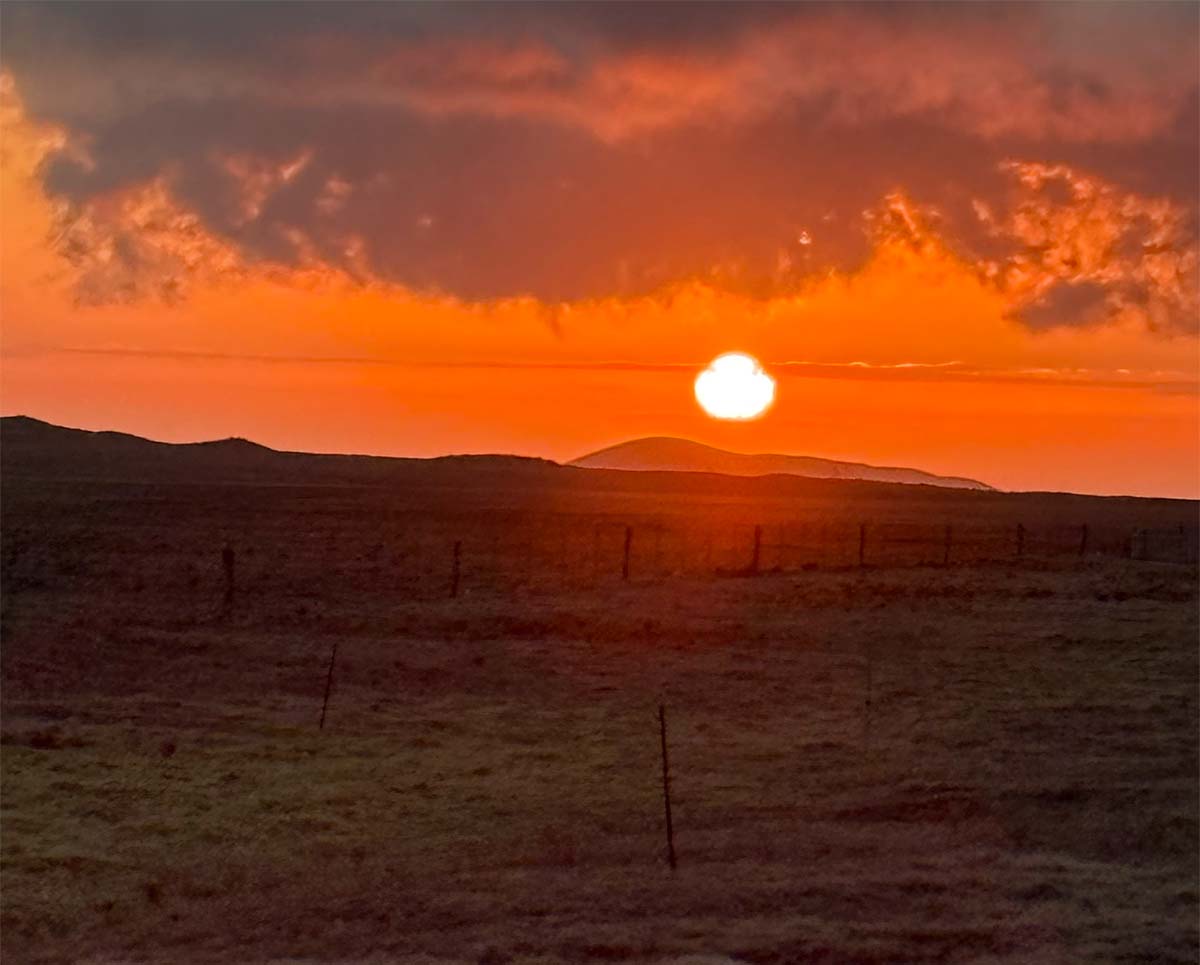
Current day sunset photo taken at the property. Photo credit: Kimo Ho’opai, Jr.
Sources
Bergin, Billy. Loyal to the Land: The Legendary Parker Ranch, 750-1950. University of Hawai’i Press, 2004.
Bergin, Billy. Personal communication. November, 2025.
Stevens Ho’opai, Lehua. Personal communication. December 4, 2025.
